It wouldn’t be wrong to say that our smart devices are almost useless without the internet. Whether you work remotely on a laptop or socialize on a smartphone, you’ll need an internet connection.
But you wouldn’t want a substandard connection that barely manages your online activities. Ideally, every internet user wants a reliable and high-speed connection that efficiently caters to their online needs.
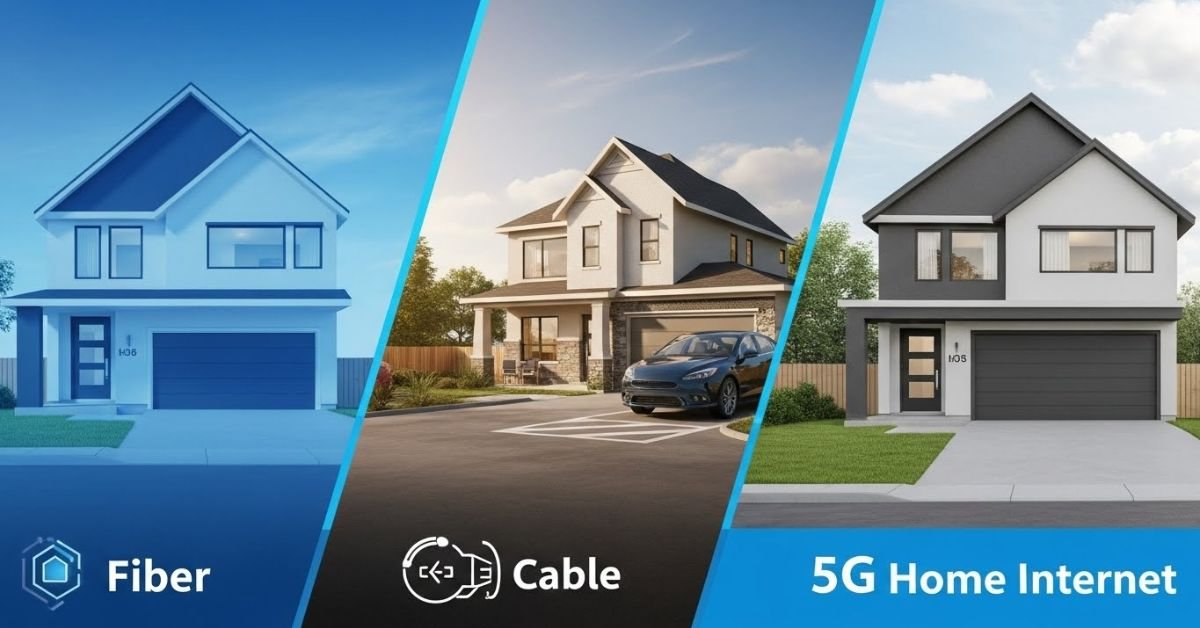
However, the question arises as to how we decide which internet connection is the best. In my opinion, 5G, cable, and fiber internet are currently some of the best internet connection types. And, here, I’ll discuss everything about them so you know which connection is best for you.
So, let’s start!
5G Home Internet
This is a relatively new technology compared to cable and fiber internet. 5G Home Internet uses towers of a cellular company to provide internet over a wireless connection.
It can be a great alternative to traditional broadband connections like cable and fiber internet. Technically, 5G internet providers install fixed signal receivers inside or outside your home. Then, it receives the internet signal from a nearby 5G cellular tower and transfers it to your home.
Most 5G Internet providers can offer download speeds ranging from 50 Mbps to 1,000 Mbps and upload speeds from 20 Mbps to 75 Mbps. In my opinion, these speeds are more than capable of handling bandwidth-intensive tasks such as HD streaming, online gaming, and video calling.
Having said that, 5G home Internet has limited availability. Although 5G internet providers are currently expanding at a rapid pace, their availability is still less than that of cable and fiber internet.
Below, I’ve listed some major pros and cons of 5G home Internet:
| Pros | Cons |
| 5G Internet is a wireless connection and does not require any cables. | 5G Internet has limited coverage and might not be available in rural areas. |
| Internet speeds are often faster than those of DSL (Digital Subscriber Line) connections. | Connection can become unstable at times. |
| 5G Internet plans can be cheap when compared to wired connections. | 5G receivers should be in a clear line of sight of the cellular towers. |
Cable Internet
With more than 82% nationwide availability, it is one of the most widely available internet connection types. A major factor why cable internet is so widely available is its infrastructure. Cable internet uses coaxial cables, the same technology that is used to deliver cable TV to our homes.
As I mentioned above, it’s a type of broadband connection, and the modem is responsible for receiving the incoming internet signals. Then, it transfers the internet signals to the router, which converts them into Wi-Fi and delivers them to the connected devices.
In terms of speed, cable internet is much faster than 5G home internet. It can offer download speeds ranging from 100 Mbps to 2,000 Mbps and upload speeds from 10 Mbps to 200 Mbps. Additionally, most cable providers allow their users to bundle various services, such as phone, cable TV, home security, and more, with internet.
However, cable internet is known to slow down during peak hours. As users in an area share bandwidth, cable providers often throttle bandwidth to manage traffic on their servers.
Below are a few pros and cons of cable internet:
| Pros | Cons |
| It is one of the most widely available internet connection types. | Users can face network congestion during peak hours. |
| Cable internet can offer faster internet speeds than DSL and 5G home Internet. | Extreme weather conditions can significantly impact cable internet. |
Fiber Internet
It is the gold standard when it comes to internet connection types. Fiber internet can exclusively offer symmetrical internet speeds, i.e., similar upload and download speeds. And, it’s one of the reasons why fiber internet is probably the fastest connection type available.
Fiber internet does not use coaxial cables.
Instead, it relies on fiber optics, a newer technology that delivers internet in the form of light signals. This way, fiber internet can easily offer symmetrical speeds ranging from 100 Mbps to 50 Gbps.
Having said that, fiber internet has only 43% nationwide availability. It is likely available in metropolitan areas. Since it’s a newer technology, developing its infrastructure is one of the biggest challenges for fiber internet providers.
And for the same reason, installing a fiber connection is expensive as well.
I’ve mentioned some pros and cons of fiber internet in the table below:
| Pros | Cons |
| It offers symmetrical speeds. | It has limited availability. |
| It is reliable and rarely affected by extreme weather conditions. | Fiber internet plans can be expensive. |
| Fiber internet providers do not impose data caps on their plans. | Installing fiber infrastructure can be challenging and expensive. |
Frequently Asked Questions
Is cable internet faster than 5G home internet?
Yes, cable internet is generally considered faster than 5G home internet because it doesn’t suffer from issues like interference and network congestion.
Which internet connection type is best for gaming?
The fiber internet connection type is best for gaming because it can offer fast, reliable speeds and keep the latency to a minimum.
What is the major difference between fiber and 5G home internet?
The major difference is that fiber internet is a wired connection, while 5G home internet does not require any cables.